Storm Prep at Liberty Harbor and Beyond: What Jersey City Apartment Residents Need to Know

Liberty Harbor | Jersey City Living Guide | Summer 2026
Summer in Jersey City brings the waterfront to life, with long evenings, active streets, and views of the Manhattan skyline that are hard to beat in the region. The same waterfront setting that defines the neighborhood makes preparation for storm season an important part of everyday living during this time of year.
Storm preparation isn’t about overreacting. It’s about having the essentials in place so that when the weather moves in, you’re prepared rather than scrambling.
Know Your Risk — What Jersey City Residents Actually Face
Jersey City sits on the western bank of the Hudson River, directly across from Lower Manhattan, bringing both access and weather exposure. Portions of the waterfront fall within FEMA flood zones, and areas of downtown experienced significant flooding during Superstorm Sandy in 2012.
Since then, infrastructure improvements across Jersey City and Hudson County have substantially strengthened drainage and flood mitigation. Still, the underlying geography remains the same, making it critical to understand your building’s exposure. Waterfront residents should know their flood zone designation. Residents can check their flood zone designation through FEMA’s Flood Map Service Center.
More commonly, summer storms in this area bring:
- Heavy rain and localized flooding in lower-lying areas
- High winds that are amplified along the waterfront and between buildings
- Power disruptions, from brief outages to longer interruptions
- Transit delays or temporary service suspensions
Most of these conditions are manageable when you’re prepared for them to occur.
Before a Storm: What to Have Ready
The best time to build a go-kit is before you need one. A basic go-kit can turn a multi-day inconvenience into something manageable.
Power and Lighting
- A fully charged portable power bank
- A battery-powered or hand-crank flashlight
- A small lantern for ambient light
- A fully charged laptop, which can serve as backup power
Food and Water
- At least three days of shelf-stable food
- One gallon of water per person per day
- A manual can opener
- Awareness of food safety timelines: about four hours for a refrigerator, up to 48 hours for a full freezer
Communications and Information
- Emergency alerts through the NJ Office of Emergency Management and Hudson County OEM
- Access to NJ Transit and NY Waterway service updates
- Familiarity with your building’s communication protocols
During a Storm: What to Do (and What Not To)
When a storm is approaching, a few decisions have the greatest impact.
- Avoid the waterfront during high winds and surge conditions
- Do not drive through flooded streets
- Limit elevator use if power conditions are unstable
- Charge devices in advance rather than during peak demand
- Check in on neighbors when possible
The most common challenge is not the storm itself, but the duration of its aftermath.
Power Outages in Apartment Buildings
Storm-related outages affect apartment living differently than single-family homes.
- Water pressure may be reduced on higher floors if electric pumps are affected
- Elevator service may be limited or unavailable
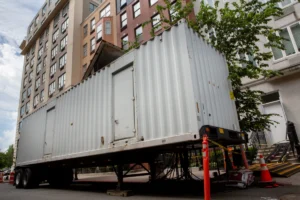
- Generator coverage varies by building and may prioritize essential systems
Planning for these differences ahead of time helps reduce disruption.
After the Storm: A Quick Recovery Checklist
- Discard refrigerated food if temperatures are above 40 degrees; when in doubt, throw it out
- Check for water intrusion and report issues promptly – under windowsills, around doors, in storage areas near exterior walls
- Avoid downed power lines and report hazards to PSE&G at pseg.com or 1-800-436-PSEG. Don’t approach them
- Allow transit systems time to return to normal operations
- Document any damage for records or insurance purposes
Staying Informed
Reliable information is essential during storm events. Recommended resources include:
- NJ 2-1-1 — dial 211 for non-emergency assistance during and after major events
- Jersey City OEM — official city emergency information and shelter locations
- Hudson County OEM — county-wide alerts and resources
- PSE&G outage map — real-time outage tracking for your address
- NJ Transit — service status for PATH, bus, and rail
- NY Waterway — ferry service updates during disruptions
Local government channels also provide timely updates specific to the neighborhood.
Storm Preparedness at Liberty Harbor
Storm preparation is most effective when it is handled in advance. Having a plan in place allows residents to respond calmly and confidently when conditions change.
At Liberty Harbor, residents receive building-level communication during significant weather events, and the on-site team works closely with the community on preparedness and response. While these guidelines apply across Jersey City, the fundamentals remain the same: understand your environment, have essential supplies ready, and know your building’s protocols.
The rest is simply weather.
Explore more lifestyle tips on the Liberty Harbor blog.